CROWNSGATE - Immortals of Aveum
Crownsgate serves as the agricultural heart of Lucium, featuring expansive crop fields and scattered farmsteads integrated into a lush, natural landscape. The region blends cottagecore-inspired aesthetics with towering Redwood forest influences, creating a serene yet grounded atmosphere that contrasts with the more fortified areas of Lucium. At the center of Crownsgate lies The Hamlet, a quaint village that acts as a narrative and gameplay stopover for players en route to the Pale Forest. The large, ethereal pale tree—visible from nearly every vantage point in Crownsgate—marks the entrance to this next major zone and serves as a natural visual guide for player navigation.
.
GAME DESCRIPTION: Immortals of Aveum is a single-player, first-person magic shooter set in the original fantasy universe of Aveum. The story follows Jak, a battlemage who joins an elite order of magic-wielders known as the Immortals to prevent the world from falling into ruin. At the heart of Aveum lies the kingdom of Lucium, a central hub that players revisit throughout the main story and side quests. However, Lucium—and the world around it—is being consumed by The Wound, a massive chasm that swallows entire cities. Both a literal and symbolic force, The Wound represents the world’s unraveling, driven by the devastating effects of the Everwar and the growing instability of magic. As both a narrative and environmental threat, it underscores the urgency of Jak's mission and the high stakes of Aveum’s collapse.
.
MY ROLE: As a Senior Environment Artist (Level Art) on Immortals of Aveum, I was responsible for managing the full production of the Lucium Hub, from initial design through to final shipping, under the guidance of Creative Director Bret Robbins and Associate Art Director Julia Litchblau. I collaborated closely with level designers to shape the hub’s layout—balancing composition, gameplay flow, and narrative beats—while leading a team of environment artists tasked with asset creation and set dressing across the region. My specific responsibilities included: Establishing and implementing the terrain and procedural generation systems, creating an artistic style guide for terrain and set dressing to ensure consistency and visual cohesion, composing and set dressing every major point of interest within the hub, and managing the hub’s production timeline, ensuring all work met performance, visual quality, and delivery targets. This role required cross-disciplinary coordination, strong visual storytelling, and a focus on optimizing both the player experience and development efficiency.

This is the dev map we used to identify different areas in Crownsgate/Thayven's Point. I will use this naming convention for identifying screenshot locations.
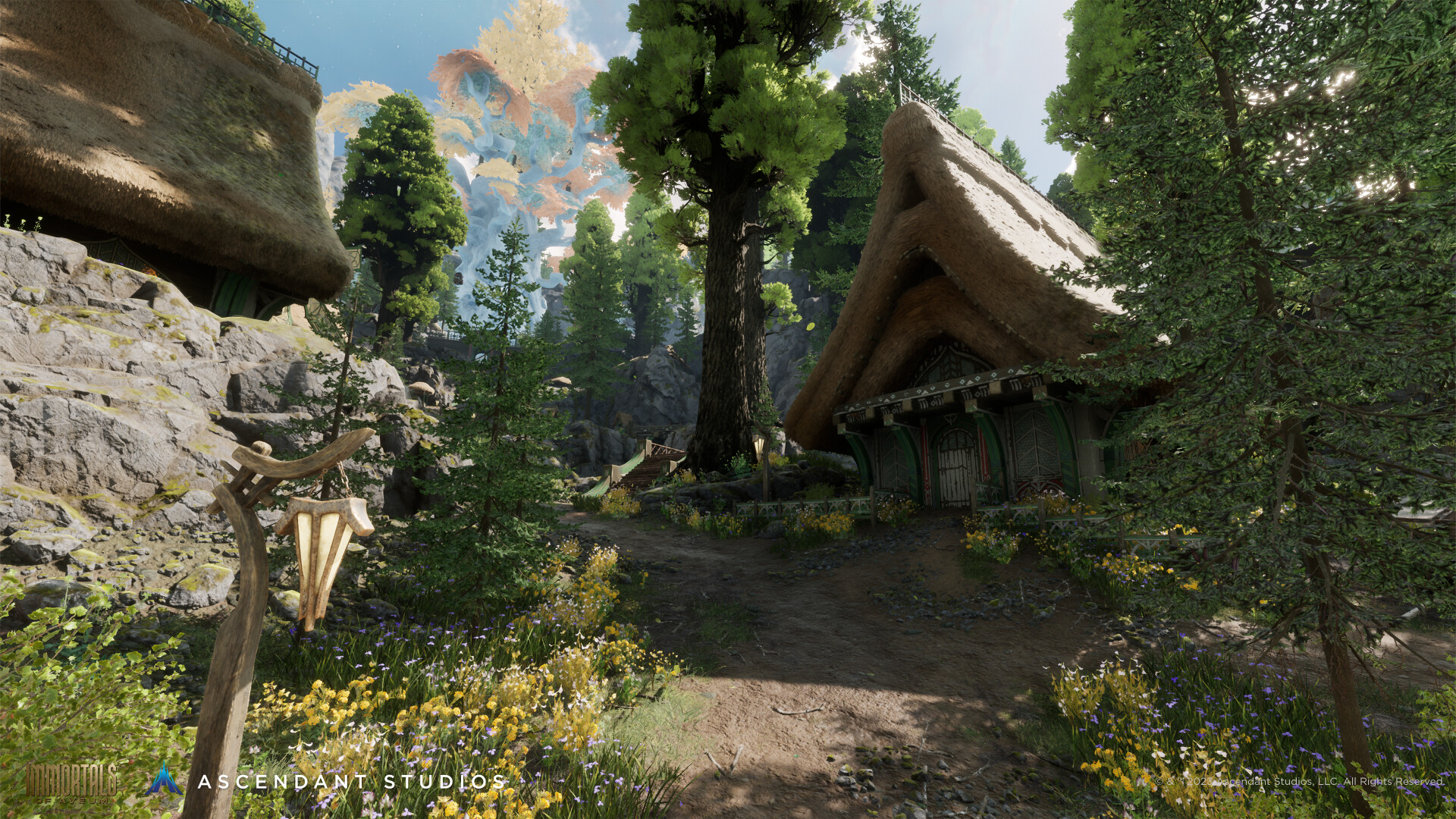
Final screenshot showcasing the more cottage-like design of the Hamlet, setting it apart from other areas of Lucium.

Crownsgate is known as the agricultural center of Lucium. The Hamlet features many farms that illustrate what life was like here before the war.

Screenshot showcasing the Hamlet Town adjacent to the entrance of the Pale Forest.

Screenshot showcasing the Hamlet Town adjacent to the entrance of the Pale Forest.

The nature and trees in Crownsgate were inspired by Redwood forests, primarily found in California.

Art proxy screenshot of the Hamlet, showing early development progress.

Art proxy screenshot of the Hamlet, showing early development progress.

Comparison shot of Crownsgate, highlighting the differences between the MVP Alpha Build (developed before my time at Ascendant) and the final shipped version.

The Lucians also keep bee farms—because everyone loves honey.

Screenshot showcasing the Crownsgate road, which naturally guides players to the entrance of the Hamlet.

Upon reaching higher ground, players can choose to either continue toward the Hamlet or attempt to cross the Wound to the cliffs on the opposite side.

Initially, the Wound was not split; instead, a mysterious Arestayan floating structure was planned to serve as a puzzle element.

Final screenshot showcasing the Hamlet entrance, which also serves as a combat zone.

Final screenshot showing the Inner Hamlet Entrance, featuring tighter layout and detailed set dressing.

Final screenshot showcasing a small resource hut accessible to players on their way to the Hamlet.

A distant view of Seren and the Seren Dock Building, visible near the entrance to the Hamlet.

A small footpath perched along the edge of a steep descent into the Wound.

A puzzle location situated near the entrance to the Hamlet, offering an optional challenge and reward.

A puzzle location situated near the entrance to the Hamlet, offering an optional challenge and reward.

A puzzle location situated near the entrance to the Hamlet, offering an optional challenge and reward.